
Kids learn by copying the grown-ups around them. One minute they are “cooking” dinner, the next they are checking a teddy bear’s temperature or fixing the sofa with a toy hammer.
The quick answer: The best pretend play toy is the one that matches what your child already likes to imitate. Kids who love cooking suit a kitchen set, kids who care for toys suit a doctor set, kids who enjoy styling suit a beauty set, and kids who like building and fixing suit a tool set. Whichever you choose, check the age label and the small-parts warning first.
This guide compares these four types of role-play toys, shows what each is best for, and covers what to check before you buy.
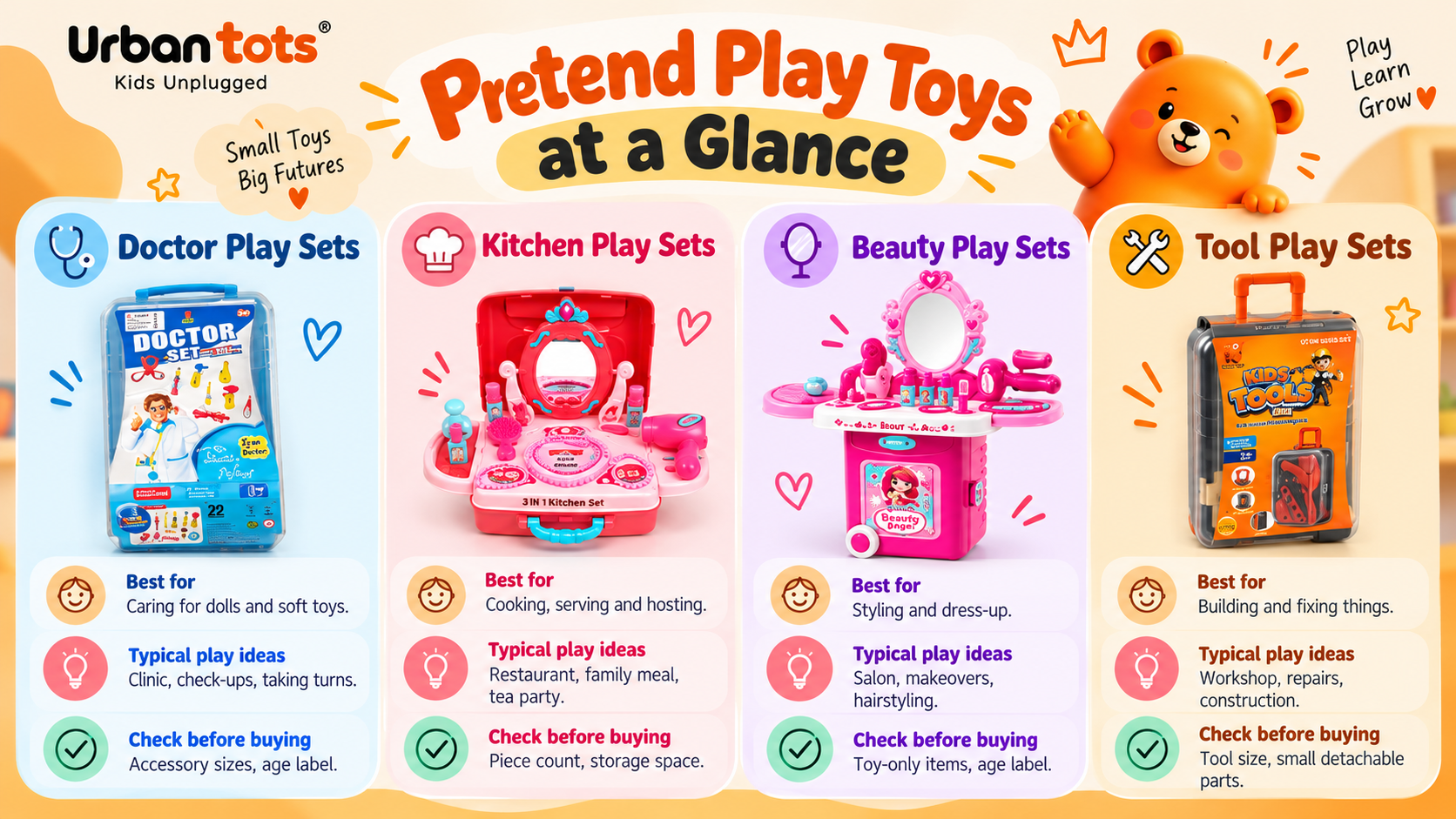
Pretend Play Toys at a Glance
1. Doctor Set
- Best for: Kids who enjoy caring for dolls and soft toys.
- Typical play ideas: Playing clinic, doing check-ups and taking turns as doctor and patient.
- Check before buying: Accessory sizes and age label.
2. Kitchen Set
- Best for: Kids who enjoy cooking, serving and hosting.
- Typical play ideas: Restaurant games, family meals and tea parties.
- Check before buying: Number of pieces and available storage space.
3. Beauty Set
- Best for: Kids who enjoy styling and dress-up.
- Typical play ideas: Pretend salons, makeovers and hairstyling.
- Check before buying: Whether the items are toy-only products and the age label.
4. Tool Set
- Best for: Kids who enjoy building and fixing things.
- Typical play ideas: Pretend workshops, repairs and construction.
- Check before buying: Tool sizes and small detachable parts.
What Are Pretend Play Toys?
Pretend play toys are toys that let children act out everyday activities or imagine themselves in a different role, such as a doctor, chef, stylist or builder. They are also called role-play toys or imaginative play toys.
The key feature is that there is no single “right” way to play. A child can use a doctor set to examine a stuffed animal, run a clinic with friends, or invent a whole story around a sick teddy. That open-endedness is what separates them from toys with one fixed outcome.
4 Types of Pretend Play Toys for Kids
Each type encourages a different kind of story. The right pick depends on your child’s interests, your play space and the specific product.
1. Doctor Play Sets: Best for Kids Who Care for Their Toys
Doctor sets let children play the doctor and treat dolls, stuffed animals or willing family members. They can set up a clinic, swap between doctor and patient, and invent simple scenarios.
Best for: Caring, role-swapping play and storytelling.
What to check: The included accessories, the age recommendation and the size of detachable pieces.
From Urban Tots: the 3-in-1 Doctor Set and the Little Doctor Set.
2. Kitchen Play Sets: Best for Kids Who Love to Cook and Host
Kitchen sets let children copy what they see at home: preparing food, serving meals and organising utensils. They suit restaurant games, family meals and tea parties.
Best for: Group play and hosting games.
What to check: The piece count, the storage needed and the age suitability. A set that fits your space gets used more often.
From Urban Tots: the 3-in-1 Kitchen Set and the Little Kitchen Set.
3. Beauty and Makeup Play Sets: Best for Kids Who Enjoy Styling
Beauty sets introduce salon-style play, hairstyling and makeovers. Children can run a pretend salon, style their dolls or build stories around a beauty parlour.
Best for: Creative, dress-up and salon role-play.
What to check: The accessories actually included and the manufacturer’s age guidance. Make sure your child knows these are pretend-play toys, not real cosmetics.
From Urban Tots: the 3-in-1 Beauty Angel Set and the Little Beauty Set.
4. Tool Play Sets: Best for Kids Who Like to Build and Fix
Tool sets let children pretend to build, repair and assemble. A child might run a workshop, play builder or “fix” a toy vehicle.
Best for: Hands-on, building-themed play.
What to check: The size and design of the tools and the product’s age label. Avoid sets with small detachable parts if they are unsuitable for your child’s age.
From Urban Tots: the Deluxe Tool Set and other tool-play sets in the catalogue.
How to Choose the Right Role-Play Toy
Four checks make the decision easier.
- Start with their interests. Watch what your child already imitates. A child who “cooks” with household items will probably enjoy a kitchen set, and one who bandages every soft toy will enjoy a doctor kit.
- Follow the age label. Check the age guidance for the specific set, not just the category. Small parts can be a choking risk for young children, and a toy designed for an older child may not suit a toddler.
- Plan for space and storage. Compact sets suit smaller rooms, while larger sets may need a dedicated corner.
- Inspect the product. Read the description and safety information, and check for damaged parts, sharp edges and loose components. Supervise play when appropriate.
What Can Children Learn Through Pretend Play?
Pretend play gives children low-pressure practice with everyday situations. Depending on how they play, it can support:
- Language and communication: describing actions, naming objects and creating dialogue between characters.
- Creativity and imagination: inventing stories and finding new ways to use a toy.
- Social skills: sharing, taking turns and agreeing on roles.
- Problem-solving: deciding what happens next and organising a pretend activity.
Every child plays differently, and no toy guarantees a particular outcome. The value lies in the opportunity to explore and interact.
Pretend Play Toys for Parents and Retailers
For parents: Choose by interest, age label and available space. Starting with one theme your child already enjoys usually works better than buying several at once.
For retailers and distributors: Doctor, kitchen, beauty and tool sets each serve a different play theme, so stocking across themes gives buyers more to compare and suits a wider customer base. Urban Tots offers all four in its Role Play Toys category, and retailers interested in a partnership can visit the Urban Tots dealer page.
Frequently Asked Questions
What are the best pretend play toys for kids?
Doctor sets, kitchen sets, beauty sets and tool sets are four popular choices. The best one depends on your child’s interests, so match the theme to what they already like to imitate, then check the age label and product details.
At what age can children start using role-play toys?
Children start pretend play at different ages. Choose according to the manufacturer’s age guidance, your child’s abilities and any small-parts warnings.
Are doctor sets good pretend play toys?
Yes. They let children create imaginary medical scenarios and swap roles between doctor and patient. Check the accessories and age suitability before buying.
What is the difference between pretend play and role play?
The terms are often used interchangeably. Pretend play means imagining situations broadly, while role play means acting out a specific character, such as a doctor or chef. Many toys support both.
How do I choose a safe pretend play set?
Read the age recommendation and safety instructions, check for damage or sharp edges, and keep small parts away from children who put things in their mouths. Supervise play where needed.
Where can retailers explore pretend-play toy options?
Retailers can browse the Urban Tots Role Play category and use the dealer page to ask about business partnerships.
Explore Pretend Play Toys from Urban Tots
Whether your child wants to cook, care for a patient, style hair or fix something, there is a role-play theme to match. Browse the Urban Tots Role Play category to see the available doctor, kitchen, beauty and tool sets.