
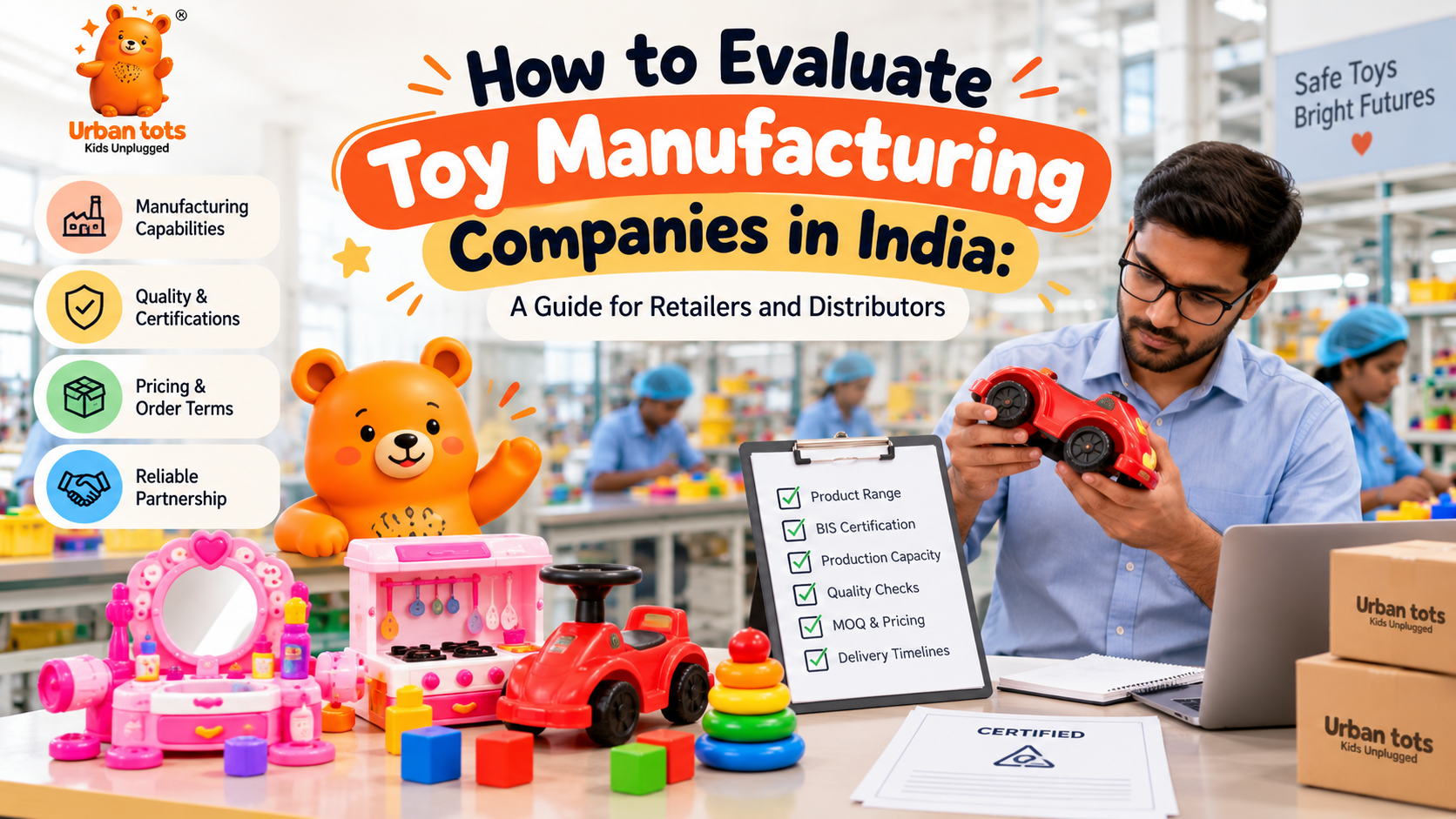
Plenty of companies say they make toys. Fewer actually run a factory, hold the right licences and can hand you a clean set of documents when you ask. If you buy in volume, that gap decides whether your next order goes smoothly or turns into weeks of emails.
This guide is for retailers, dealers and distributors who want to judge a manufacturer on substance: what they can make, how they check quality, what paperwork they can show, and whether their terms fit your business.
What Makes a Toy Manufacturer Suitable for Your Business?
Product categories and manufacturing capabilities
Start by asking what they really make in-house and what they source from elsewhere. Some companies mould, assemble and pack on one site. Others design a product and outsource the rest. Neither is wrong, but you should know which one you’re dealing with, because it changes who is responsible when something goes wrong.
Then match categories to your shop. A manufacturer strong in ride-ons may not be the right fit if you mainly sell baby toys.
Production capacity and repeat-order requirements
A factory that handles a small first order can struggle when you double it. Ask about monthly output, how far ahead they plan and what happens when demand spikes. If you sell heavily around festivals or school holidays, ask how they handle that rush before you’re in the middle of it.
Product development, moulding and private-label options
If you want your own brand or a custom design, ask early. Find out whether they develop their own moulds, how long a new product takes from idea to shelf, and who owns the tooling. Private-label work can be a good route, but only if the terms around moulds, minimums and exclusivity are written down.
How to Verify Toy Quality and Certification Claims
Check applicable toy safety requirements
In India, toys have been under mandatory BIS certification since January 2021 under the Toys (Quality Control) Order. Non-electric toys fall under IS 9873 (Part 1), and electric toys fall under IS 15644. So a BIS mark isn’t a bonus feature. It’s the baseline. Some manufacturers also test to international standards such as EN71 for export or wider market needs.
Review certificates and product documentation
Ask to see the actual licence and test reports, not a logo on a brochure. Check that the licence covers the product you’re buying and the factory it’s made in. BIS licences are granted for specific manufacturing premises, so a certificate for one unit doesn’t automatically cover another. Look at the dates too, and ask what happens when a licence comes up for renewal.
Ask how quality checks are carried out
A good answer is specific. Do they inspect raw material when it arrives? Do they check products during production and again before packing? Who signs off? Ask how they handle a batch that fails. If the answer is vague, assume the process is too.
How to Compare Manufacturers Before Placing an Order
Product specifications, pricing and minimum order quantities
Ask each manufacturer for the same information: product specs, materials, age grading, packaging details, price and minimum order quantity. Comparing like with like is the only way to see a real difference. Remember to include freight, taxes and packaging in your cost per piece, and to weigh MOQ against your storage and cash flow.
Production timelines and dispatch arrangements
Get lead times for a first order and a repeat order, since they’re often different. Ask how dispatch works, who arranges transport and how products are packed to prevent breakage. A promised date means little unless it’s in writing.
Communication, repeat supply and issue resolution
Pay attention to how they behave before you’ve paid. Do they reply on time? Do they answer the question you asked? Find out who handles problems after dispatch, how damage is reported and how quickly replacements or credits are sorted. The way a manufacturer treats a small query often shows how they’ll treat a big complaint.
Questions to Ask an Indian Toy Manufacturer
Which products can the manufacturer supply?
Ask for a current catalogue, age ranges and the categories they produce themselves. Check whether the items you want are standard products or made to order.
What production and quality documents are available?
Request BIS licence details, test reports, material information, product specs and packaging details. Ask whether they can supply these before you order, not after.
What are the order quantities, timelines and commercial terms?
Ask for MOQ by category, lead times, payment terms, damage and replacement policy, and conditions for repeat orders. Get it all in one written document so nothing relies on memory.
Evaluating Urban Tots as a Potential Manufacturing Partner
Here is what is publicly known about Urban Tots so that you can check it against your own requirements.
Urban Tots is the consumer brand of Deepak Houseware & Toys Limited, headquartered at the RIICO Industrial Area in Pathredi, Bhiwadi, Rajasthan. According to a company press release, it operates from a 350,000-square-foot manufacturing facility in Bhiwadi and employs more than 750+ people. The same release says its products are made in line with standards including EN71 and BIS, and that, besides its own brand, it manufactures toys for other companies that sell under different labels. The company began with role-play trolley products before moving into more categories.
Its current range includes educational toys, electronic and battery-operated toys, ride-on toys, plush toys, musical and light toys, and pretend-play sets. The website also lists dealer and export sections, a catalogue and a certificates page.
None of this replaces your own checks. Ask for the BIS licence and test reports for the specific products you plan to buy. Request current MOQs and lead times in writing. If you’re interested in private-label work, ask about moulds, development time and exclusivity before you commit.
Looking for a toy partner that covers every age and category? Explore Urban Tots Kids Unplugged, from baby rattles and educational sets to ride-ons, musical toys and outdoor play. Get in touch to discuss bulk orders, dealership or private-label options.
Frequently Asked Questions
How do I evaluate toy manufacturing companies in India?
Look at what they actually make, their capacity, certification, quality checks, pricing and how they communicate. Ask for documents, request samples and visit the factory if you can. Compare at least two or three manufacturers on the same specs.
What should retailers ask a toy manufacturer?
Ask which products they make themselves, what certificates they hold, what the MOQ and lead times are, how quality is checked, and how damage or delays are handled. Also ask what support you get on repeat orders.
What certifications should toy buyers verify?
In India, check for BIS certification and the ISI mark, which has been mandatory for toys since January 2021. Confirm the licence covers the product and the factory it comes from. Depending on your market, EN71 test reports can also be useful.
What is the difference between a toy manufacturer, supplier and wholesaler?
A manufacturer makes the toys, usually in its own factory. A supplier provides toys to buyers and may make them, source them or both. A wholesaler buys in bulk from manufacturers or suppliers and resells to retailers. Buying direct from a manufacturer can give you more control over specs and customisation, while wholesalers often offer smaller quantities and mixed orders.